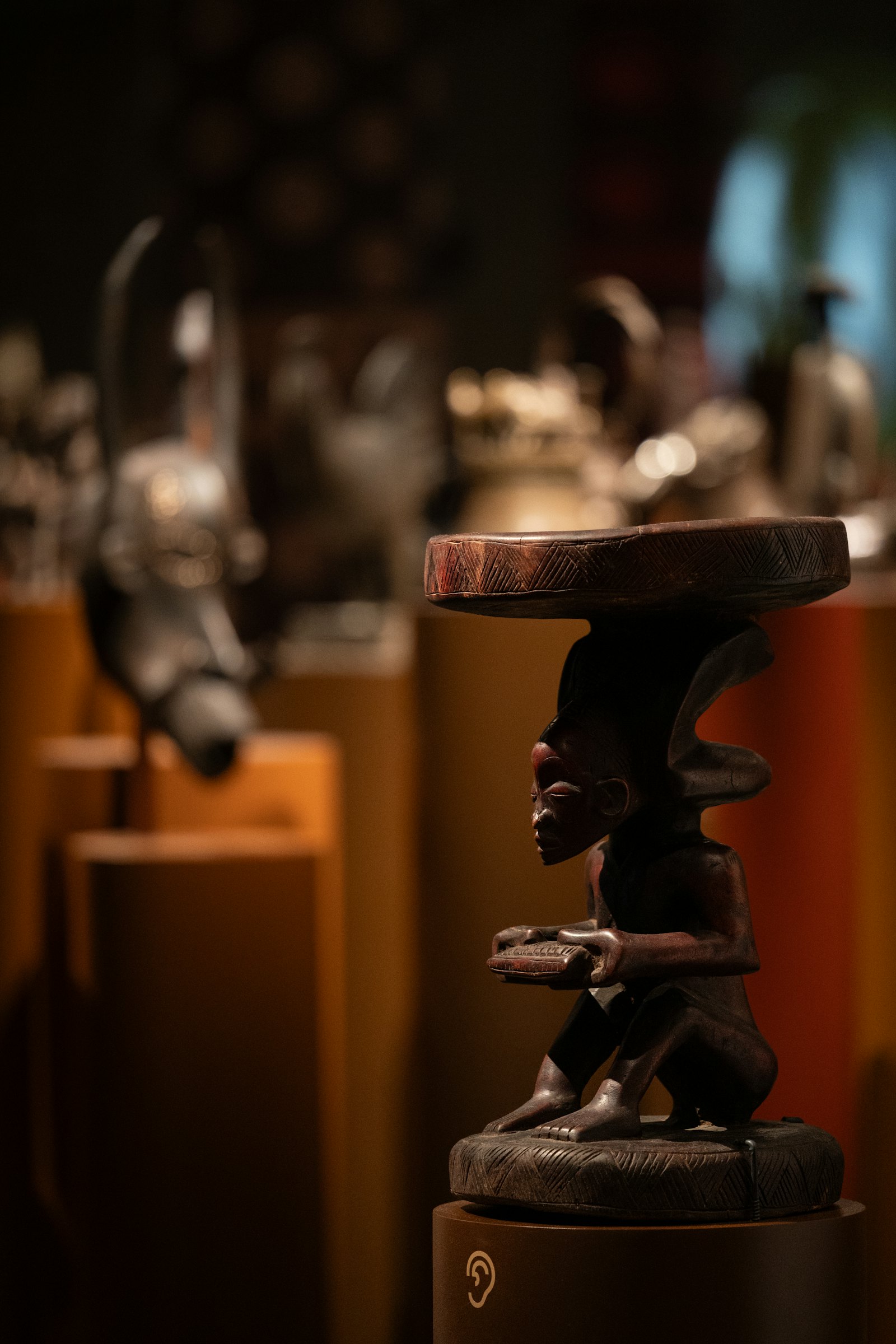
The stool is one of the oldest pieces of African furniture, and one of the most loaded with meaning. Many are carved from a single block of wood, with no joints or nails. Depending on the people who made it, a stool could be an everyday seat, a mark of status, or an object so sacred no one may sit on it.
The Asante stool, Ghana
Among the Asante (Ashanti) of Ghana, a stool is far more than a seat. The classic form has a curved seat resting on a central support, sometimes carved with symbols, above a flat rectangular base. A personal stool was believed to hold something of its owner's spirit.
The most famous is the Golden Stool, Sika Dwa Kofi, which embodies the soul of the Asante nation. No one sits on it, not even the king, and it is never allowed to touch the ground. Many Adinkra symbols appear on Asante stools.
The Senufo stool, West Africa
Senufo stools come from the Senufo peoples of northern Côte d'Ivoire, Mali and Burkina Faso. They are low, sturdy and simple: a thick round or rectangular seat on short legs, carved in one piece. Made as everyday seats, often for farm work, they have become some of the most popular African pieces in Western homes because their plain, sculptural shape fits almost anywhere.
Bamileke stools, Cameroon
The Bamileke and other kingdoms of the Cameroon Grassfields carve round stools with an openwork base: a lattice of figures, leopards or the stylised spider, which stands for wisdom. Stools covered in glass beads were reserved for kings and dignitaries. Simpler carved versions, often in dark wood, are now widely made as side tables.
Ethiopian three-legged stools
In southwestern Ethiopia, stools are carved with three legs and a concave seat, which keeps them steady on uneven ground. Their clean, almost modernist lines make them a favourite with designers.
How to tell them apart
| Asante (Ghana) | Curved seat, central support, flat rectangular base |
|---|---|
| Senufo (Côte d'Ivoire, Mali, Burkina Faso) | Low, thick round or rectangular seat, short legs |
| Bamileke (Cameroon) | Round seat on an openwork base of figures, leopards or spiders; sometimes beaded |
| Ethiopian | Three legs, concave seat, smooth carved finish |
How to use an African stool at home
- As a side table beside a sofa or bed: a Bamileke or Senufo stool is the right height.
- As a plant stand, raising a pot to eye level.
- As sculpture, alone on a plain wall or in a hallway, where its shape can be seen from all sides.
- In a bathroom, to hold towels: oil the wood first and keep it away from standing water.
Buy with care. Most stools sold today are new, made by carvers who still work in these traditions, and that is a good thing to support. Be wary of pieces sold as "antique" without paperwork: real old stools are rare and expensive, and some were taken from their communities. Ask the seller where and when the piece was made.
Questions people ask
What does an African stool symbolise?
It depends on the people. Among the Asante of Ghana a stool can hold its owner's spirit, and the Golden Stool embodies the soul of the nation. Bamileke stools decorated with spiders or leopards signal wisdom and power. Senufo stools were mostly everyday seats.
What is a Senufo stool?
A low, sturdy stool carved from a single block of wood by the Senufo peoples of northern Côte d'Ivoire, Mali and Burkina Faso, traditionally used as an everyday seat.
What is a Bamileke stool?
A round stool from the Cameroon Grassfields with an openwork base carved with figures, leopards or spiders. Beaded versions were reserved for kings and dignitaries.
Can I use an African stool as a side table?
Yes. Bamileke and Senufo stools are a good height for a side table next to a sofa or bed, or as a plant stand.