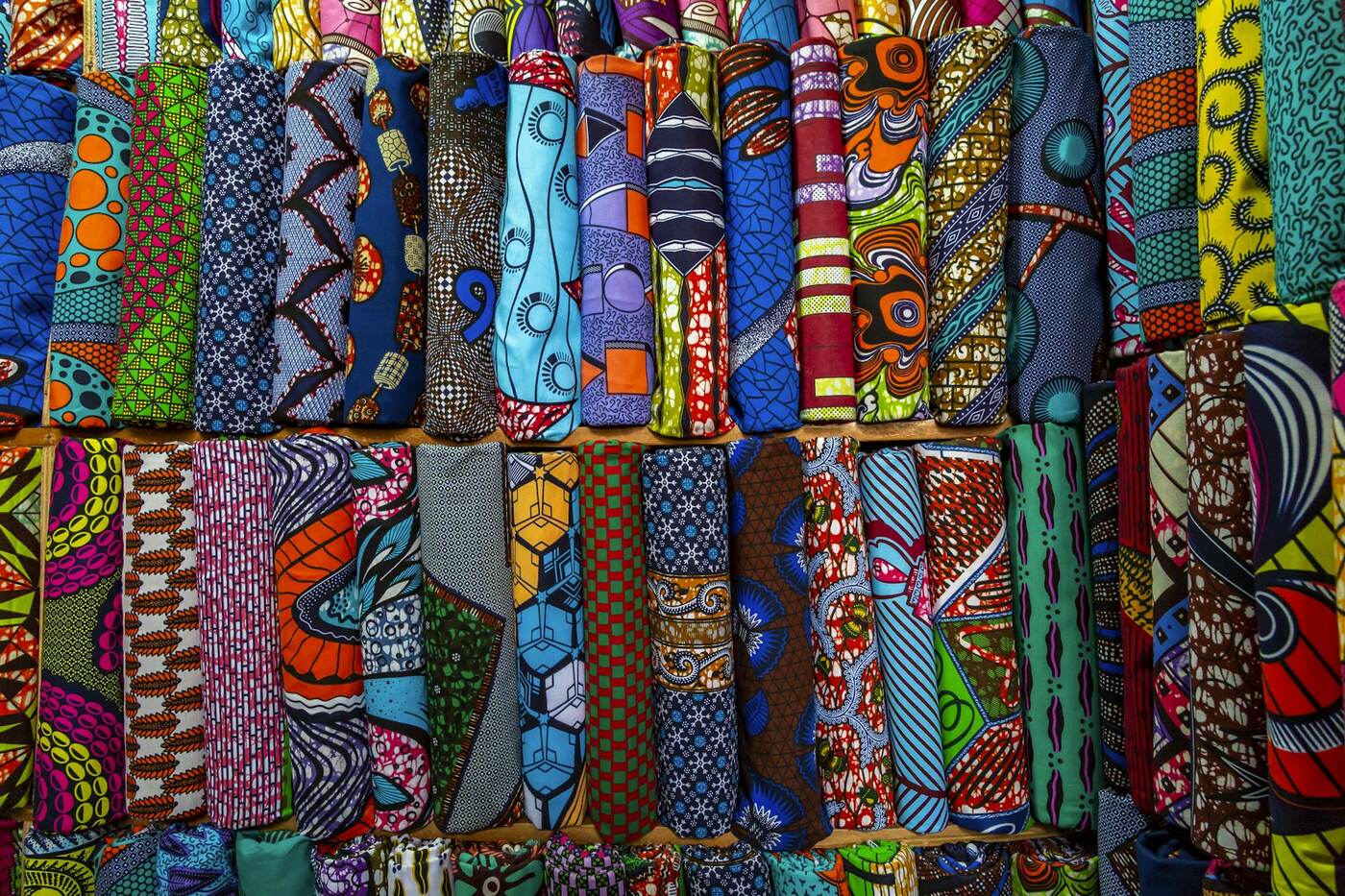
African wax print, also called ankara or Dutch wax, is a brightly patterned cotton fabric printed with a wax-resist technique. It's worn across West and Central Africa for everyday clothes, celebrations and statement outfits, and it has become a global fashion fabric.
A story from Java to West Africa
In the 19th century, Dutch manufacturers developed industrial methods to imitate batik, the hand-drawn wax-resist cloth of Java in Indonesia, then a Dutch colony. The machine-made copies weren't a success in Indonesia, but they found an enthusiastic market on the West African coast, carried there by traders.
West African buyers shaped the fabric from then on. Influential market women, such as the traders of Lomé in Togo known as the "Nana Benz", decided which designs sold, and customers gave patterns their own names and meanings. A famous Vlisco design of birds and a cage is known as "Si tu sors, je sors" ("If you go out, I go out"), a joke about a jealous partner.
The main makers
- Vlisco (Netherlands), founded in Helmond in 1846, is the best-known and most expensive brand.
- GTP and ATL in Ghana, and Uniwax in Côte d'Ivoire, produce wax prints in West Africa.
- Many cheaper "fancy" or imitation prints are produced elsewhere, including large volumes from China.
How to tell real wax print
- Both sides are bright. Real wax print is dyed through, so the back is almost as vivid as the front. Cheaper prints are pale on the reverse.
- Look for the crackle. The wax cracks during production, leaving fine irregular veins of colour. No two metres are exactly alike.
- Small misalignments are normal. Colours that slightly miss their outline are a sign of the process, not a defect.
- Check the selvedge. Brands print their name, and often the design number, along the edge.
- Feel it. New wax print is stiff and slightly waxy, then softens after washing.
Wax print is usually sold in pieces of 6 yards (about 5.5 m), enough for a full outfit, or 12 yards for a family or matching set.
Using wax print at home
- Cushion covers, lampshades and table linen are easy projects for a single piece.
- Stretch a large print over a frame as wall art.
- Re-cover a dining chair seat or a headboard.
- Pick one dominant colour from the print and repeat it once elsewhere in the room.
Questions people ask
Is African wax print actually African?
Wax print was first industrialised by Dutch manufacturers imitating Indonesian batik, but West African traders and wearers shaped its designs, names and meanings, and it is now produced in Ghana, Côte d'Ivoire and elsewhere. It is widely considered an African textile.
What is the difference between ankara and wax print?
The words are often used interchangeably. Strictly, real wax print uses a wax-resist process and is bright on both sides, while many cheaper prints sold as ankara are printed on one side only.
How many yards of wax print do I need?
Wax print is usually sold in 6-yard pieces, about 5.5 metres, which is enough for a full outfit.
Which wax print brand is best?
Vlisco is the best-known premium brand. GTP, ATL and Uniwax are respected West African producers.